
Key Features & Advantages
Technical Specifications & Material Grades
| Parameter | Specification Details |
| Standard Compliance | API 5L (PSL1/PSL2), ASTM A671, ASTM A672, EN10210, EN10219, GB/T 9711 |
| Material Grade | Gr.B, X42, X52, X60, X65, X70, X80, S355JR |
| Outer Diameter (OD) | 406 mm to 1422 mm (16" to 56") |
| Wall Thickness (WT) | 8 mm to 60 mm |
| Length Options | 6.0 m to 12.5 m (Standard or Customized lengths) |
| Welding Process | Double-sided Submerged Arc Welding (DSAW) |
| Surface Treatment | Bare (uncoated), Black Paint, 3PE (Three-Layer Polyethylene), FBE (Fusion Bonded Epoxy) Coating, Galvanized |
Quality Control & Inspection (NDT)
· 100% X-Ray Radiographic Inspection: Performed along the full length of the longitudinal weld seam to detect any potential internal defects, including porosity, slag inclusion, or lack of fusion.
· Automatic Ultrasonic Testing (UT): Applied to the weld seam to monitor joint integrity and scanned across the plate body to check for laminations and wall thickness consistency.
· Magnetic Particle Testing (MT): Conducted on pipe ends to ensure the absence of surface or near-surface cracks in the critical bevel zones.
· Hydrostatic Pressure Test: Every pipe is subjected to a mandatory water-pressure test, held for at least 5 to 10 seconds, to verify structural seal integrity under maximum design pressures.
· Mechanical & Metallurgical Testing: Comprehensive destructing testing is executed on test coupons, including tensile, flattening, and Charpy V-Notch impact tests.
· Full Product Traceability: Supplied with a certified EN 10204 3.1 Mill Test Certificate (MTC). Third-party inspections by agencies such as SGS or Bureau Veritas (BV) are welcomed.
Dimensional Control & Mechanical Expansion
Mechanical expansion physically stretches the pipe body from the inside out using a series of segmented dies. This process optimizes the final geometric dimensions, relieving internal residual welding stress while ensuring excellent ovality (out-of-roundness tolerances) and straightness along the entire length of the pipe.
Processing & Customization Services
Frequently Asked Questions (FAQ)
A: We primarily utilize advanced JCOE forming technology (and UOE for specific mass orders). JCOE processes ensure that the steel plate is progressively bent with high precision, maintaining minimal residual stress. After double-sided submerged arc welding (inside and outside), the entire pipe body undergoes Full Mechanical Expansion. This crucial step significantly optimizes the geometric dimensions, ensuring excellent ovality and straightness for seamless site fit-up.
A: Given that LSAW pipes are widely used in high-pressure applications, our quality control is absolute. 100% of our LSAW pipes undergo a comprehensive testing regime: X-ray Radiographic Inspection and Automatic Ultrasonic Testing (UT) for the entire weld seam length, Magnetic Particle Testing (MT) for pipe ends, and a mandatory Hydrostatic Test held for at least 5-10 seconds to guarantee zero-leakage security under extreme pressure.
A: Our JCOE production line specializes in large-diameter and heavy-wall configurations. We supply Outside Diameters (OD) from 16″ to 56″ (406mm to 1422mm) with Wall Thicknesses (WT) up to 60mm. We can also source custom steel plates to meet specific high-yield heavy structural or piling project specifications.
A: Our LSAW pipes comply strictly with international oil, gas, and structural standards. We offer API 5L (PSL1 & PSL2, grades from Gr.B up to X80), ASTM A672/A671 (for atmospheric and lower temperatures), and EN 10210 / EN 10219 / ASTM A572 for heavy structural piling. All products are fully traceable and supplied with an EN 10204 3.1 Mill Test Certificate (MTC). Third-party inspection (SGS, BV) is also welcomed.
A: Compared to SSAW (Spiral Welded) pipes, LSAW (Longitudinal Welded) pipes feature a much shorter weld seam length per pipe, significantly reducing the potential risk area for defects. LSAW pipes offer superior stress distribution, tighter dimensional tolerances, and are much less prone to stress corrosion cracking under high-pressure line pipe transmission or heavy dynamic structural loading, making them the safest choice for critical infrastructure.
Related Steel Solutions
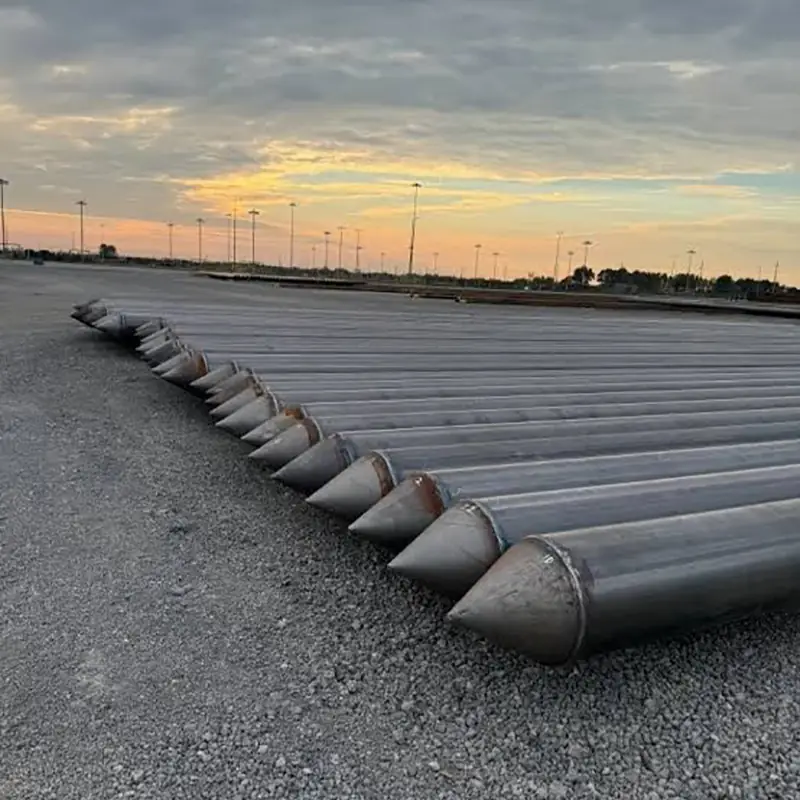
Bitumen Coated Piling Steel Pipe 813mm OD 12.7mm WT for Corrosive Soil Protection
Engineered to provide an exceptionally robust and cost-effective foundation barrier in the most aggressive subterranean…
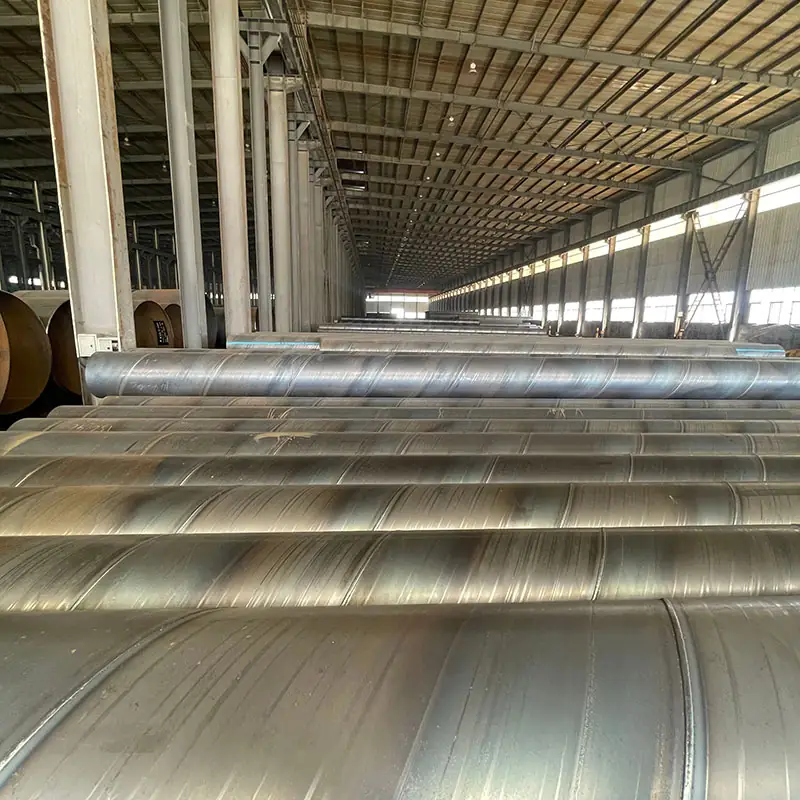
EN 10219 S355J2H LSAW Steel Pipe Pile 36 Inch 25.4mm WT for Offshore Wind Farm
Engineered to withstand the relentless cyclic wave actions and immense structural loads of offshore renewable…
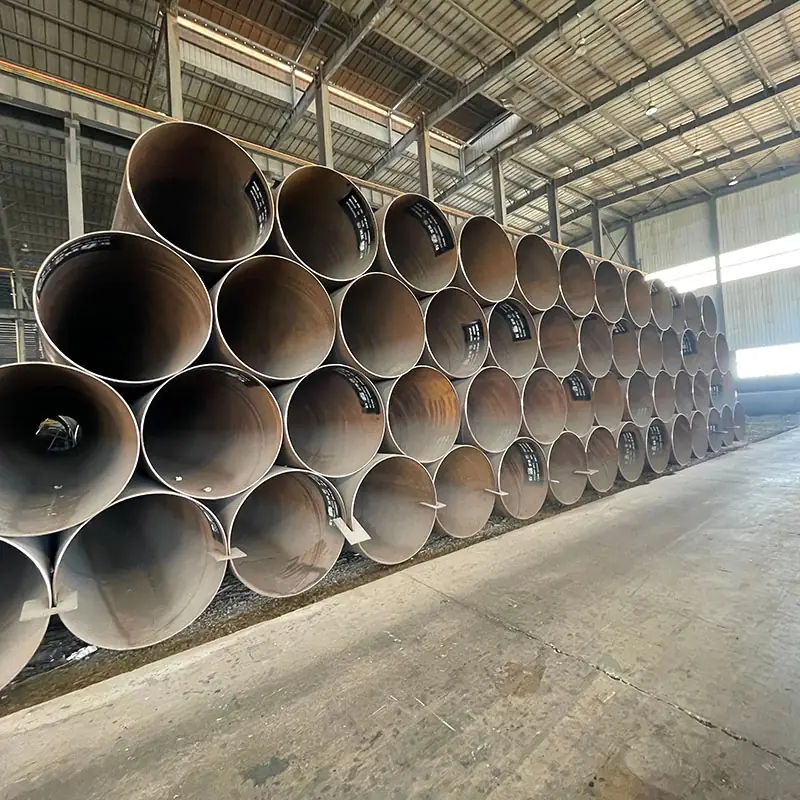
ASTM A500 Grade B Welded Piling Pipe 406mm OD with Conical Point for Soil Piling
Engineered to provide excellent ground consolidation and dependable end-bearing capacity, this ASTM A500 Grade B…
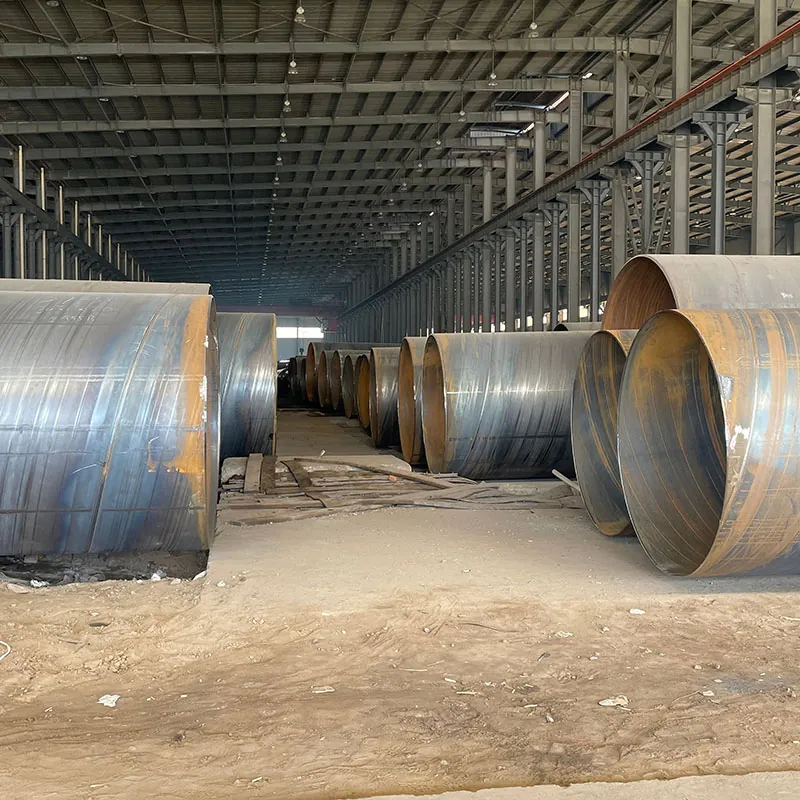
Heavy Wall Thickness SSAW Piling Pipe 1220mm OD for Marine Port Construction
Engineered to withstand the extreme dynamic loads and aggressive corrosive environments of maritime infrastructure, this…